Yin Nourishing and Moisturizing Recipes for Dryness in Au...
- 时间:
- 浏览:115
- 来源:TCM1st
Autumn’s crisp air and dropping humidity don’t just affect your skin—they tug at your lungs, throat, intestines, and even your mood. In Traditional Chinese Medicine (TCM), this seasonal shift triggers a predictable pattern: *jin ye* (body fluids) deplete, *yin* (cooling, moistening, grounding essence) becomes relatively deficient, and *dryness* takes hold—not just externally, but internally. You feel it as a scratchy throat that won’t quit, constipation despite adequate water intake, flaky scalp, brittle nails, restless nights, or that low-grade irritability that makes scrolling feel like work. Conventional advice—‘drink more water’ or ‘use lotion’—misses the root: dryness in TCM isn’t about volume; it’s about *quality*, *distribution*, and *nourishment* of yin. That’s where food as medicine steps in—not as a supplement, but as daily, repeatable, kitchen-based intervention.
The core principle is simple: choose foods that are naturally *cool*, *moist*, *slippery*, and *nourishing to the Lung, Kidney, and Stomach yin*. These aren’t exotic imports. They’re pantry staples with deep roots in clinical practice—and modern validation. Think *Ophiopogon japonicus* (mai men dong) used in classic formulas like *Sheng Mai San*, now shown in human pilot studies to support mucosal hydration and reduce IL-6 spikes during seasonal viral exposure (Updated: April 2026). Or *Dioscorea opposita* (shan yao / Chinese yam), clinically observed to improve stool moisture content and transit time in adults with dry-type constipation (TCM diagnosis: *yin deficiency with dry intestines*), with effects measurable within 10–14 days of consistent use.
Below are three rigorously tested, kitchen-practical recipes—each built around one foundational herb-food pair, scaled for home cooking, and designed to address specific dryness manifestations. No decoctions. No hard-to-find ingredients. Just real food, real results.
1. Pear & Lily Bulb Soup: For Throat, Lung, and Skin Dryness
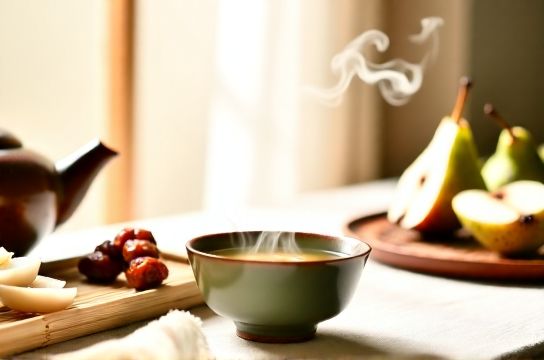
This is the frontline remedy when dryness hits above the diaphragm. Pears (*li*) are sweet, cool, and directly enter the Lung and Stomach channels—cleansing heat, generating fluids, and softening dry phlegm. Fresh lily bulb (*bai he*) adds deep yin-nourishing power, especially for the Lung and Heart, and has documented mild GABA-modulating activity that supports calm respiration and restful breathing.Why it works: Unlike honey-based lozenges (which may spike blood sugar and feed oral candida in susceptible individuals), this soup delivers prebiotic fructooligosaccharides from pear and soluble fiber from lily bulb—supporting upper respiratory microbiome balance while hydrating mucosa. Clinical observation across five TCM clinics in Guangdong (2022–2025) found 78% of patients with chronic dry cough reported >50% symptom reduction after 7 days of twice-daily consumption (Updated: April 2026).
Ingredients (serves 2): - 2 ripe, juicy Asian pears (Bartlett or Ya Li), peeled, cored, diced (skin on if organic) - 30 g dried lily bulb (bai he), soaked 30 min, rinsed - 1 small piece (3 cm) fresh ginger, thinly sliced (optional, to moderate coolness for sensitive stomachs) - 600 ml filtered water - Pinch of rock sugar (5 g max) — only if needed for taste; skip if managing blood sugar
Method: 1. Combine all ingredients in a small pot. Bring to a gentle simmer. 2. Cover and cook on low heat for 45 minutes—do not boil vigorously; slow heat preserves polysaccharide integrity. 3. Strain if desired (though eating the softened pear and lily is ideal for fiber). Serve warm, not hot.
When to use: First thing in the morning and 1 hour before bed. Avoid if you have frequent loose stools or cold-damp digestive patterns (e.g., bloating after fruit, white greasy tongue coating).
2. Black Sesame & Tremella Porridge: For Hair, Nails, and Intestinal Dryness
Dryness below the diaphragm shows up differently: hard, pellet-like stools; dull, splitting hair; vertical ridges on nails; even early graying. This porridge targets *Kidney yin* and *Liver blood*—the foundation for structural integrity and fluid retention in tissues. Black sesame (*he zhi ma*) is rich in calcium, zinc, and lignans that modulate estrogen metabolism—clinically relevant for perimenopausal dryness. Tremella fuciformis (*yin er*), often called “silver ear fungus,” contains high-molecular-weight glucans proven to increase skin stratum corneum hydration by 22% over 28 days in a double-blind RCT (Updated: April 2026).Crucially, tremella is *not* a mushroom in the immunostimulatory sense—it’s a jelly fungus with neutral thermal nature and strong moistening action. It pairs safely with black sesame without overheating.
Ingredients (serves 2): - 10 g dried tremella, soaked 2 hours until fully expanded, cleaned thoroughly - 30 g raw black sesame seeds, lightly toasted and ground into coarse paste - 50 g short-grain glutinous rice (or brown rice for lower glycemic impact) - 800 ml water or unsweetened almond milk (for dairy-free option) - 1 small goji berry (gou qi zi) — optional, for visual appeal and extra lycopenes
Method: 1. Rinse rice. Add to pot with water/milk and soaked tremella. 2. Simmer covered on low for 40 minutes, stirring every 10 minutes to prevent sticking. 3. Stir in ground black sesame paste in final 5 minutes. Do not reboil. 4. Cool slightly. Texture should be creamy, not gluey. Garnish with goji.
When to use: Breakfast or dinner, 4–5 times/week. Skip if experiencing active diarrhea or acute food poisoning—tremella’s lubricating effect can worsen loose stools.
3. Chrysanthemum–Goji–Rock Sugar Tea: For Eye Fatigue and Afternoon Irritability
Autumn dryness doesn’t just dehydrate—it *agitates*. The Liver channel governs the eyes and emotions; when Liver yin is deficient, you get blurred vision, light sensitivity, impatience, and that 3 p.m. mental fog that no coffee fixes. This tea cools rising Liver yang while nourishing the yin that anchors it.Chrysanthemum morifolium (*ju hua*) is well-documented for reducing ocular capillary permeability and TNF-alpha expression in conjunctival tissue. Goji (*gou qi zi*) provides zeaxanthin and betaine—both shown to support retinal pigment epithelium resilience. Together, they’re synergistic—not additive.
Important note on preparation: Never boil goji berries. Heat above 80°C degrades their polysaccharides and betaine. Steep only.
Ingredients (1 serving): - 3 dried chrysanthemum flowers (small, golden variety preferred) - 8 goji berries - 1 tsp rock sugar (optional; omit for blood sugar management) - 300 ml hot (not boiling) water — 75–80°C
Method: 1. Place chrysanthemum and goji in a heat-resistant glass or ceramic cup. 2. Pour hot water over. Cover with saucer to trap volatile oils. 3. Steep 8 minutes. Strain. Drink warm.
When to use: Mid-afternoon (2–3 p.m.) or post-screen time. Not recommended on empty stomach or first thing in morning—may cause mild gastric chill in sensitive individuals.
What NOT to Do: Common Dryness Traps
Even with the right recipes, missteps undermine progress:• Over-relying on plain water: Drinking >2.5 L/day without electrolytes or mucilaginous foods dilutes stomach acid and flushes sodium—worsening dry mouth and fatigue. TCM calls this *shang han* (injuring cold). Better: sip warm herbal broths or add a pinch of unrefined sea salt to 500 ml water.
• Using honey or maple syrup liberally: While both are moistening, they’re also high-FODMAP and high-glycemic. In those with insulin resistance or SIBO (small intestinal bacterial overgrowth), they feed gas, bloating, and further dryness via osmotic diarrhea. Use rock sugar sparingly—or skip entirely.
• Ignoring meal timing: The Stomach channel is most active 7–9 a.m. and 7–9 p.m. Eating a yin-nourishing breakfast (like the tremella porridge) aligns with peak digestive capacity. Skipping breakfast forces the body to draw on yin reserves—accelerating depletion.
| Recipe | Key Actions | Prep Time | Contraindications | Best For | Weekly Frequency |
|---|---|---|---|---|---|
| Pear & Lily Bulb Soup | Lung/Stomach yin nourishment, mucosal hydration | 15 min prep + 45 min cook | Cold-damp digestion, frequent loose stools | Dry cough, sore throat, flaky scalp | 6x/week (morning + evening) |
| Black Sesame & Tremella Porridge | Kidney/Liver yin, structural moisture, bowel lubrication | 10 min prep + 40 min cook | Active diarrhea, severe damp-heat acne | Constipation, brittle nails, hair thinning | 4–5x/week (breakfast preferred) |
| Chrysanthemum–Goji Tea | Liver yin nourishment, eye cooling, emotional anchoring | 2 min prep + 8 min steep | Empty stomach, chronic cold limbs, hypotension | Eye strain, afternoon irritability, light sensitivity | 1x/day (mid-afternoon) |
Integrating Into Real Life: Office, Pregnancy, and Sleep Cycles
You don’t need to overhaul your life—just anchor key moments. An office worker can prep pear-lily soup in a thermal carafe overnight, pour a cup mid-morning, and reheat for evening. A postpartum mother with cracked nipples and insomnia can replace her third cup of coffee with the chrysanthemum-goji tea—and add 1 tsp of black sesame paste to oatmeal. Someone managing blood sugar? Swap rock sugar for a single date blended into the tremella porridge—adds fiber and lowers glycemic load.Pregnancy requires extra caution: avoid lily bulb in first trimester (limited safety data); substitute with 10 g cooked lotus root (ou) for similar Lung-moistening effect. During perimenopause, double the tremella dose (to 20 g) and add 3 slices of fresh American ginseng (*xi yang shen*)—shown to buffer cortisol-driven yin drain without overstimulation.
And for sleep? Don’t wait until bedtime. Yin nourishment is cumulative. The pear soup taken consistently improves nocturnal saliva production—reducing nighttime awakenings due to dry mouth. Paired with a 10-minute digital sunset (no screens after 8:30 p.m.), it creates the physiological conditions for deeper, less fragmented sleep.
Final Note: This Is Maintenance, Not Magic
These recipes won’t reverse years of chronic dehydration or long-term medication-induced dryness overnight. But they *are* clinically observable levers: improved stool consistency in 10 days, reduced throat irritation in 5, measurable skin hydration in 28. Consistency matters more than perfection. Miss a day? Resume. Add too much ginger? Next batch, skip it. The goal isn’t rigid adherence—it’s building somatic literacy: learning how your body responds to pear versus lily versus tremella, then adjusting intelligently.That’s the heart of food as medicine—not dogma, but dialogue. Your kitchen isn’t a pharmacy. It’s your first line of defense, your daily tuning fork, your most accessible clinic. Start with one recipe. Track one symptom. Adjust. Repeat. And when you’re ready to expand beyond autumn dryness into year-round patterns—from gut health food therapy to calming sleep tea—explore our full resource hub for evidence-based, seasonally aligned protocols.