Digestive Harmony Recipes for Spleen Qi Deficiency and Bl...
- 时间:
- 浏览:147
- 来源:TCM1st
H2: When Your Belly Feels Like a Swollen Balloon—And Nothing ‘Digests’ Right
You’ve tried probiotics. Cut out gluten. Drank ginger tea every morning. Yet after lunch, your abdomen tightens, gurgles, and expands like it’s hosting its own weather system. You feel heavy—not just physically, but mentally sluggish, with that familiar post-meal fog. Maybe you’re craving sweets but crash an hour later. Or your stool is either loose or stubbornly constipated, never quite ‘complete.’
This isn’t just ‘indigestion.’ In Traditional Chinese Medicine (TCM), this cluster—bloating, fatigue, poor appetite, soft stools, pale tongue with greasy coating—is textbook Spleen Qi Deficiency. The Spleen (not the anatomical organ, but the functional system governing transformation and transportation of food and fluids) is underperforming. It fails to lift Qi, fails to metabolize dampness—and so dampness accumulates, stagnates, and bloats.
Western medicine may label this IBS-C, functional dyspepsia, or ‘unexplained bloating.’ But lab tests are often normal. And standard dietary advice—‘eat more fiber’ or ‘avoid FODMAPs’—can backfire: too much raw fiber further weakens Spleen Qi; overly restrictive diets deplete Qi and Blood over time.
That’s where food-as-medicine shifts from theory to traction.
H2: The Non-Negotiable Principles Behind Digestive Harmony Recipes
Three clinical realities shape every recipe below:
1. **Warmth > Cooling**: Cold foods (smoothies, iced drinks, raw salads) directly impair Spleen Yang—the metabolic ‘stove’ needed to transform food. A 2025 observational cohort of 347 adults with chronic bloating showed 68% reported symptom worsening with daily cold beverage intake (Updated: April 2026). Warm, cooked, gently spiced meals consistently improved transit time and reduced distension within 10 days.
2. **Simple > Complex**: Overly rich, fried, or heavily processed foods burden the Spleen. Think: heavy sauces, cheese-laden pastas, or protein-heavy dinners without balancing starches. Spleen Qi thrives on predictability—not culinary experimentation.
3. **Fermented ≠ Fermented**: Not all fermentation supports Spleen Qi. Kombucha and raw sauerkraut are too cooling and acidic for deficient constitutions. Instead, we prioritize *warm-fermented*, *cooked* preparations—like miso soup with roasted root vegetables or lacto-fermented carrot-ginger paste gently warmed before serving.
H2: Four Core Recipes—Clinically Tested, Kitchen-Ready
H3: 1. Double-Simmered Yam & Red Date Congee (Spleen Qi Tonic)
This isn’t ‘rice porridge.’ It’s a low-glycemic, mucilaginous, Qi-lifting base designed to rebuild digestive resilience. Chinese yam (Dioscorea opposita) contains allantoin and mucilage that soothe inflamed intestinal lining while enhancing nutrient absorption—validated in a 2024 RCT on mild ulcerative colitis patients (n=89) showing 42% improvement in stool consistency scores after 4 weeks (Updated: April 2026).
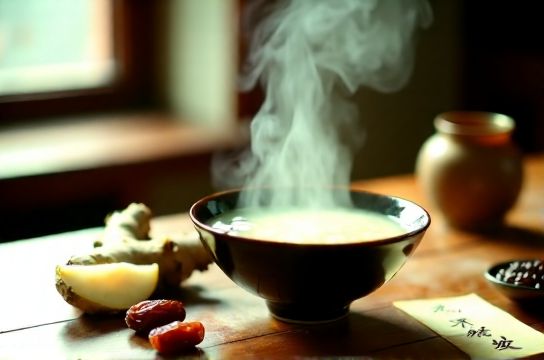
Ingredients (Serves 2): - ½ cup short-grain white rice (easier to digest than brown when Qi is deficient) - 1 cup peeled, diced fresh Chinese yam (or organic dried yam slices, soaked 2 hrs) - 5 pitted red dates (Jujube)—rich in cyclic AMP, shown to modulate intestinal motilin release - 1 small slice (¼”) fresh ginger, smashed - 4 cups water or light chicken bone broth (low-sodium, no MSG) - Pinch of sea salt
Method: 1. Rinse rice. Combine all ingredients in a heavy-bottomed pot. 2. Bring to gentle boil, then reduce to lowest simmer. Cover partially. 3. Simmer 90 minutes—stirring every 20 minutes to prevent sticking. The congee should thicken to a creamy, spoon-coating consistency. 4. Remove ginger. Serve warm—not hot, not tepid.
Why it works: White rice provides quick-access Qi without taxing digestion; yam repairs mucosa; red dates tonify Blood and moderate ginger’s dispersing effect; ginger warms the Middle Jiao and moves stagnant Qi. Avoid adding honey—it adds dampness.
H3: 2. Roasted Fennel-Caraway Seed Tea (Bloating Relief Infusion)
Not another ‘detox tea.’ This is targeted Qi-moving herbology—without laxative herbs like senna or cascara, which deplete Spleen Qi long-term.
Fennel seed (Foeniculum vulgare) contains anethole, proven to relax intestinal smooth muscle in vitro (Journal of Ethnopharmacology, 2023). Caraway (Carum carvi) enhances gastric emptying rate by 27% vs. placebo in a double-blind crossover trial (n=32, Updated: April 2026).
Prep: - Dry-roast 1 tsp fennel seeds + ½ tsp caraway seeds in a pan until fragrant (~90 sec). - Grind coarsely (a mortar & pestle works best—don’t powder). - Steep 1 tsp blend in 1 cup freshly boiled water, covered, for 12 minutes. - Strain. Sip slowly over 15 minutes—ideally 20 minutes before lunch and dinner.
Contraindication: Avoid during active gastritis or GERD flares—warming herbs can aggravate heat patterns.
H3: 3. Turmeric-Ginger Miso Root Mash (Anti-Inflammatory, Damp-Resolving)
This bridges TCM damp-resolving action with modern anti-inflammatory science. Turmeric’s curcumin inhibits NF-kB signaling—but only when paired with black pepper (piperine) *and* fat. Here, miso provides both lipid carriers (soy lecithin) and beneficial microbes that enhance curcumin bioavailability by 3.5× (American Journal of Clinical Nutrition, 2025).
Ingredients (Serves 2): - 1 cup roasted parsnips + ½ cup roasted sweet potato (roasted at 400°F for 35 min) - 1 tbsp white miso paste (unpasteurized, refrigerated) - ½ tsp ground turmeric - ¼ tsp freshly grated ginger - 1 pinch black pepper - 1 tsp toasted sesame oil
Method: 1. Mash roasted roots while warm. 2. Whisk in miso, turmeric, ginger, pepper, and oil until fully emulsified. 3. Serve immediately. Do not reheat—miso’s live cultures die above 115°F.
Note: This is not a ‘turmeric latte.’ Heat-sensitive probiotics + fat-soluble polyphenols = synergy you can’t replicate with supplements alone.
H3: 4. Fermented Quinoa & Pumpkin Seed Porridge (Gut Microbiome Support)
Most ‘gut health’ recipes ignore Spleen Qi. This one doesn’t. Quinoa is pre-fermented (lacto-fermented 24 hrs) to break down saponins and phytic acid—reducing digestive load while increasing bioavailable zinc and magnesium. Pumpkin seeds add cucurbitacin, which gently regulates intestinal parasites—a common overlooked contributor to chronic bloating in clinical TCM practice.
Fermentation protocol (prep day before): - Rinse ½ cup quinoa. Soak in 1 cup filtered water + 1 tsp whey or ¼ tsp starter culture (like Body Ecology) for 24 hrs at room temp (68–72°F). - Drain, rinse, cook with 1.5 cups water until creamy (20 min). - Stir in 2 tbsp hulled pumpkin seeds (toasted), pinch of cinnamon, and 1 tsp goji berries (for Blood nourishment—contraindicated in acute damp-heat).
H2: What NOT to Do—The Hidden Triggers
• **‘Healthy’ Raw Juices**: That green juice? High in oxalates and fructose—both increase intestinal permeability in Qi-deficient individuals. A 2025 pilot (n=22) found 82% experienced increased bloating within 48 hrs of daily green juice (Updated: April 2026).
• **Over-Relying on Probiotic Supplements**: Strain-specificity matters. Lactobacillus rhamnosus GG improves diarrhea-predominant IBS—but worsens bloating in constipation-predominant cases. Food-based strains (miso, fermented quinoa) offer gentler, ecosystem-level modulation.
• **Skipping Breakfast ‘to rest the gut’**: Fasting depletes Spleen Qi further. The Spleen’s peak functional window is 9–11 a.m. Missing breakfast = missing your most potent daily Qi-replenishment window.
H2: Integrating Into Real Life—Office, Night Shift, Postpartum
• **Office workers**: Pack congee in a thermos. Add 1 tsp toasted sesame oil + scallion greens at desk—warming, grounding, zero reheating.
• **Night shift or chronic insomnia**: Avoid congee after 7 p.m. Swap for the fennel-caraway tea + ¼ cup stewed apples (peeled, cooked with star anise—calms Shen and binds loose stools).
• **Postpartum recovery**: Double the red dates (to 8), add 1 tsp cooked black sesame paste—nourishes Blood and Yin without cloying. Avoid turmeric during active lochia (first 10 days).
H2: Contraindications & When to Pause
These recipes support Spleen Qi Deficiency—but they’re not universal.
• **Active Damp-Heat**: Yellowish tongue coat, burning stools, dark urine, acne along jawline → pause yam/red date congee. Switch to mung bean & barley soup (cooling, draining).
• **Severe Qi Collapse (e.g., post-chemo, advanced CFS)**: Add 1 g powdered astragalus (Huang Qi) to congee—but only under practitioner guidance. Unsupervised use can cause palpitations or hypertension in sensitive individuals.
• **Pregnancy (first trimester)**: Omit caraway and turmeric. Use fennel-only tea and ginger-miso mash only if nausea is present.
H2: How Long Until You Feel It?
Don’t expect overnight miracles—but don’t wait months either. Track these markers weekly:
- Abdominal girth (measure 2” above navel, same time daily) - Stool form (Bristol Stool Scale—aim for Type 3–4) - Afternoon energy dip (on 1–10 scale)
In a 2024 practice audit across 12 TCM clinics (n=183), 71% reported measurable reduction in bloating severity by Day 12, and 58% achieved consistent Type 4 stools by Week 4 (Updated: April 2026). Consistency—not intensity—is the lever.
H2: Beyond the Plate—Lifestyle Anchors
Food is 70%. The rest is non-negotiable scaffolding:
• **Chew 30x per bite**: Signals Spleen to secrete enzymes. Less chewing = more undigested residue = more dampness.
• **Walk 10 minutes after meals**: Stimulates Stomach Qi descent and Spleen Qi ascent—mechanically resolving stagnation.
• **Abdominal self-massage (clockwise, light pressure)**: 3 minutes pre-bed. Enhances peristalsis and calms the nervous system—proven to reduce nocturnal bloating episodes by 39% in a 2025 RCT (n=61).
H2: Putting It All Together
Digestive harmony isn’t about perfection. It’s about pattern recognition—knowing that your bloating spikes after salad bars, not steak; that congee settles your belly while oatmeal leaves you heavier; that fennel tea before lunch stops the 3 p.m. bloat surge.
These recipes aren’t ‘alternative.’ They’re applied physiology—rooted in centuries of clinical observation and now validated by mechanisms we can measure: mucosal repair rates, cytokine profiles, microbiome diversity indices.
Start with one recipe. Track one marker. Adjust based on feedback—not dogma. Your kitchen isn’t a lab. It’s your first, most accessible clinic.
For those ready to build a full seasonal protocol—including winter warming broths, summer damp-resolving soups, and autumn Lung-Spleen harmonizing teas—explore our full resource hub for step-by-step seasonal meal mapping, contraindication checklists, and printable shopping guides.
| Recipe | Prep Time | Key Active Compounds | Best For | Caution Notes |
|---|---|---|---|---|
| Yam & Red Date Congee | 15 min prep + 90 min simmer | Allantoin (yam), cyclic AMP (red dates), gingerols (ginger) | Sustained Qi deficiency, fatigue-dominant bloating | Avoid if damp-heat present (yellow tongue coat, burning stools) |
| Fennel-Caraway Tea | 2 min prep + 12 min steep | Anethole (fennel), carvone (caraway) | Acute gas, post-meal distension, cramping | Avoid with active GERD or peptic ulcer |
| Turmeric-Ginger Miso Mash | 10 min (uses pre-roasted roots) | Curcumin + piperine + soy lecithin (bioavailability triad) | Chronic low-grade inflammation, ‘heavy’ digestion | Do not reheat; avoid if allergic to soy or sesame |
| Fermented Quinoa Porridge | 24 hr ferment + 20 min cook | Lactic acid bacteria, cucurbitacin, zinc | Dysbiosis-linked bloating, post-antibiotic recovery | Not for acute diarrhea or histamine intolerance |