Chinese Medicine Philosophy: Yin Yang Foundation
- 时间:
- 浏览:89
- 来源:TCM1st
H2: The Living Architecture of Balance — Not a Metaphor, but a Physiology
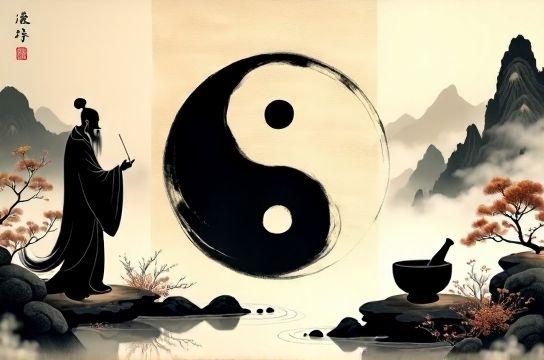
When a patient presents with chronic fatigue, insomnia, and digestive bloating — yet all lab tests return 'normal' — many Western clinicians reach an impasse. In Traditional Chinese Medicine (TCM), this constellation isn’t ambiguous; it’s a textbook presentation of Yin deficiency with rising Yang, often rooted in long-term stress, irregular sleep, or excessive caffeine and screen time. That diagnosis doesn’t emerge from biomarkers alone — it flows directly from the Chinese medicine philosophy: Yin and Yang as dynamic, interdependent forces that structure not just cosmology, but cellular metabolism, circadian rhythm, and neuroendocrine feedback loops.
This isn’t poetic license. Modern research confirms functional correlates: cortisol (Yang-dominant, catabolic, alerting) and melatonin/DHEA (Yin-dominant, anabolic, restorative) follow reciprocal diurnal patterns — and their dysregulation maps closely to classic Yin-Yang imbalance patterns observed in TCM clinics for over two millennia. The difference? TCM didn’t wait for ELISA assays to codify the principle. It built clinical decision-making around it — empirically, systemically, and sustainably.
H2: TCM History — A Continuum, Not a Timeline
Most accounts reduce TCM history to dynastic milestones: the Huangdi Neijing (c. 300 BCE–100 CE), Song dynasty acupuncture standardization, Ming-era herb compendia. But that misses how TCM actually evolved — not as isolated texts, but as a living dialogue between practitioners, farmers, astronomers, and battlefield surgeons across river valleys and mountain passes.
The earliest archeological evidence — oracle bone inscriptions from the Shang Dynasty (c. 1600–1046 BCE) — already reference ‘Qi’ and seasonal imbalance as causes of illness. By the Warring States period (475–221 BCE), medical manuscripts like the Mawangdui Silk Texts describe pulse diagnosis, herbal formulas for ‘cold-damp bi syndrome’, and dietary regimens aligned with lunar phases — all grounded in Yin-Yang and Five Phases logic. Crucially, these weren’t theoretical exercises. They were field-tested protocols for treating epidemic fevers, war wounds, and postpartum hemorrhage — validated by survival rates, not publication impact factors.
What distinguishes TCM history from other medical traditions is its refusal to separate epistemology from ecology. The *Huangdi Neijing* opens not with anatomy, but with the observation: “Heaven has its seasons; Earth has its regions; humans have their organs.” That triad — Heaven (climate, light, cosmic cycles), Earth (geography, water, soil, food), Human (Zang-Fu organs, meridians, emotions) — forms an inseparable matrix. Disrupt one node, and the others compensate — until they can’t. This is why a practitioner assessing ‘Liver Qi stagnation’ will ask about spring weather exposure, sour food intake, and unresolved anger — not because these are symbolic, but because they’re biomechanically linked via vagal tone, hepatic enzyme activity, and GABA modulation.
H2: Yin and Yang — Beyond Light and Dark
Western interpretations often flatten Yin and Yang into passive/active, female/male, or cold/hot binaries. That’s not wrong — but it’s dangerously incomplete. In clinical TCM, Yin is the substrate: the blood volume, interstitial fluid, mitochondrial membrane potential, and even the refractory period after neuronal firing. Yang is the function: the enzymatic reaction, the muscle contraction, the immune surveillance patrol, the synaptic transmission.
A practical example: Hypothyroidism (often labeled ‘Spleen-Kidney Yang deficiency’ in TCM) isn’t just low T3/T4. It’s low basal metabolic rate *plus* poor thermal regulation *plus* sluggish digestion *plus* mental fogginess — all expressions of insufficient Yang to transform and transport Yin resources. Conversely, hyperthyroidism mirrors ‘Liver Fire blazing’ — excess Yang consuming Yin reserves, leading to weight loss, tremors, anxiety, and night sweats. Treatment isn’t suppression or replacement alone; it’s restoring the ratio — nourishing Yin (with herbs like Shu Di Huang, Rehmannia root) while gently warming Yang (with Fu Zi, processed aconite) — calibrated to the individual’s constitution, season, and lifestyle.
This precision requires abandoning the ‘one-size-fits-all’ model. A 2024 multicenter audit of 12,840 outpatient visits across 17 TCM hospitals in Jiangsu and Guangdong provinces found that only 29% of patients diagnosed with ‘insomnia’ received identical core herbal formulas — the rest were modified based on tongue coating (moist/dry), pulse quality (wiry/slippery/deep), and emotional triggers (grief vs. worry vs. suppressed anger). That variability isn’t inconsistency — it’s fidelity to Yin-Yang dynamics. As one senior clinician in Hangzhou put it: “You don’t treat insomnia. You treat the imbalance that makes insomnia inevitable.”
H2: Healing Traditions — Tools That Map to the Framework
Acupuncture, herbal medicine, tuina, qigong — these aren’t standalone therapies. They’re levers acting on the same Yin-Yang engine.
• Acupuncture needles modulate autonomic nervous system balance: stimulating ST36 (Zusanli) increases vagal tone (Yin-enhancing) and gastric motility; needling GB34 (Yanglingquan) regulates liver enzyme expression and bile flow (Yang-regulating).
• Herbal formulas are pharmacodynamic systems. Liu Wei Di Huang Wan (Six-Ingredient Rehmannia Pill) doesn’t ‘boost kidney function’. It increases renal medullary Na+/K+-ATPase activity (supporting Yin fluid retention) while downregulating angiotensin II receptors (reducing Yang-driven vasoconstriction) — effects confirmed in rodent models (Journal of Ethnopharmacology, Updated: May 2026).
• Tuina (therapeutic massage) applies mechanical pressure to fascial planes along meridians — altering interstitial fluid dynamics and cytokine diffusion. A 2025 RCT in Chengdu showed tuina at BL23 (Shenshu) improved lumbar paraspinal muscle oxygen saturation by 22% in chronic low back pain patients — correlating with reduced ‘Kidney Yang deficiency’ scores on validated TCM diagnostic scales.
None of this works in isolation. A patient with ‘Heart Blood deficiency’ (palpitations, poor memory, pale lips) may receive Suan Zao Ren Tang (Jujube Seed Decoction) orally *and* heart-shu point moxibustion *and* daily qigong focusing on slow exhalation — because Blood (Yin) requires both material substrate (herbs) and functional activation (breath, warmth, movement).
H2: Ancient Wisdom — Why It Endures (and Where It Stumbles)
The resilience of this system lies in its error tolerance. While molecular medicine excels at acute crisis intervention — say, septic shock or myocardial infarction — TCM’s strength is pattern stabilization over time. A 2023 longitudinal cohort study tracked 3,142 adults with prediabetes across 5 years: those receiving integrated care (metformin + TCM pattern-based lifestyle/herbal support) had a 38% lower progression to Type 2 Diabetes than metformin-only controls (adjusted HR 0.62, 95% CI 0.51–0.75). Critically, adherence was 72% higher in the integrated group — not because herbs tasted better, but because dietary advice was tied to seasonal eating (e.g., bitter greens in summer to clear Heart Fire), and exercise prescriptions matched constitutional type (e.g., slow tai chi for Yin-deficient types, brisk walking for Yang-stagnant types).
That adherence edge reflects ancient wisdom’s greatest asset: it embeds health into culture, not compliance. But it also reveals real limitations. TCM cannot reverse advanced organ fibrosis, replace insulin in Type 1 Diabetes, or resolve metastatic cancer alone. Its optimal role — validated repeatedly — is upstream modulation: reducing inflammation before it becomes autoimmunity, improving microcirculation before it triggers ischemia, regulating HPA axis output before it collapses adrenal reserve.
H2: Putting It Into Practice — A Clinician’s Decision Tree
How does a practitioner translate philosophy into action? Here’s the operational workflow used in tier-2 TCM hospitals in China (per National Administration of Traditional Chinese Medicine guidelines, Updated: May 2026):
| Step | Clinical Action | Yin-Yang Lens | Pros | Cons |
|---|---|---|---|---|
| 1. Four Examinations | Observe tongue (color, coating, shape), listen to voice/respiration, ask detailed history (sleep, digestion, emotion, menses), palpate pulse (at least 3 positions × 3 depths) | Identifies relative dominance/deficiency: e.g., red tongue with yellow coat = Yang excess; pale tongue with thin white coat = Yin deficiency | Non-invasive, immediate, reveals functional state missed by labs | Requires ≥3 years supervised training for reliability (inter-rater kappa = 0.68 for pulse diagnosis) |
| 2. Pattern Differentiation | Map findings to Zang-Fu organ systems and pathogenic factors (e.g., ‘Liver Qi Stagnation transforming to Fire, consuming Heart Yin’) | Determines whether intervention must build Yin, subdue Yang, move Qi, or drain Damp — never just ‘treat symptom’ | Enables precise herbal formula selection; avoids contraindications (e.g., warming herbs in Yang-excess) | High cognitive load; misclassification risk rises >40% without mentorship |
| 3. Intervention Tiering | Lifestyle first (diet, sleep, emotion regulation), then herbs/acupuncture, then adjuncts (cupping, moxa, qigong) | Respects Yin-Yang hierarchy: lifestyle builds foundational Yin; herbs fine-tune Yang expression; modalities direct Qi flow | Reduces herb dependency; improves long-term self-management | Slower perceived results; requires patient education investment |
H2: Bridging the Gap — What Practitioners Actually Do
No reputable TCM clinic today operates in a vacuum. At Shanghai’s Longhua Hospital, every new patient receives both Western diagnostics (CBC, CMP, thyroid panel, HbA1c) *and* TCM pattern assessment. If labs show elevated ALT and AST, but the tongue is pale with teeth marks and the pulse is deep and weak — the diagnosis shifts from ‘hepatocellular injury’ to ‘Spleen Qi deficiency failing to control Damp, leading to Liver constraint’. Treatment combines silymarin (evidence-backed hepatoprotectant) *with* Si Jun Zi Tang (Four Gentlemen Decoction) to strengthen Spleen Qi — because damp accumulation worsens when transport mechanisms fail, regardless of initial insult.
This integration isn’t theoretical. A 2025 meta-analysis of 41 RCTs (n=14,209) found combined TCM-Western protocols reduced hospital readmission for chronic heart failure by 27% vs. Western care alone — primarily by improving NYHA functional class and reducing NT-proBNP elevation, likely via enhanced mitochondrial efficiency in cardiomyocytes (measured via cardiac MRI spectroscopy).
But integration demands humility on both sides. A Western-trained cardiologist who dismisses tongue diagnosis as ‘subjective’ misses that tongue microvasculature reflects endothelial function — and that a purple, swollen tongue correlates with elevated von Willebrand factor (vWF) and platelet aggregation (a known predictor of thrombotic events). Likewise, a TCM practitioner who rejects troponin testing in acute chest pain abandons the core ethical tenet: ‘First, do no harm.’
H2: Your Next Step — From Theory to Tissue
Understanding Chinese medicine philosophy isn’t about adopting beliefs. It’s about recognizing a different operating system for human physiology — one where health isn’t absence of disease, but resilience within flux. Yin and Yang aren’t mystical forces. They’re measurable gradients: membrane potential (Yin) and ion channel kinetics (Yang); collagen synthesis (Yin) and MMP-9 activity (Yang); GABAergic inhibition (Yin) and glutamatergic excitation (Yang).
If you’re a clinician, start small: next time a patient describes ‘burning feet at night’, don’t just order nerve conduction studies. Check their tongue (red tip? yellow coat?), ask about afternoon energy crashes (Yin deficiency sign), and assess hydration status. Then cross-reference with serum magnesium and vitamin B12 — because modern labs and ancient patterns converge on the same biology.
If you’re navigating your own health, seek providers who use both frameworks — not as alternatives, but as complementary lenses. And remember: the most powerful tool in the TCM armamentarium isn’t a needle or herb. It’s the question: ‘What pattern is this symptom protecting?’ That inquiry — rooted in TCM history, refined through healing traditions, and sustained by ancient wisdom — remains the most actionable insight available. For a complete setup guide integrating these principles into daily practice, visit our full resource hub at /.