Ancient Wisdom Astronomical Calendars and Chronobiology i...
- 时间:
- 浏览:105
- 来源:TCM1st
H2: The Sky as Physician — When Time Was a Diagnostic Tool
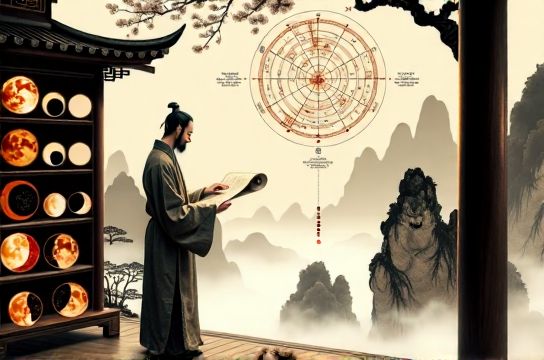
In a Beijing clinic last spring, a practitioner adjusted a patient’s acupuncture schedule not by symptom severity alone, but by the lunar phase and solar term. The patient, recovering from chronic fatigue, received tonifying points on the Spleen and Kidney meridians only during the ‘Jingzhe’ (Awakening of Insects) solar term — when Earth’s qi begins rising and dampness lifts. This wasn’t intuition. It was protocol rooted in the *Huangdi Neijing* (c. 300 BCE–100 CE), where Chapter 67 states: ‘The wise physician observes the heavens before needling the body.’
That sentence isn’t poetic metaphor. It’s operational doctrine — one that binds celestial mechanics, seasonal shifts, and human physiology into a single functional system. And yet, outside specialist circles, this dimension of TCM remains under-taught, often mislabeled as ‘folklore’ rather than rigorously codified chronobiology.
H2: Not Myth — A Systematic Chronobiological Framework
TCM’s temporal architecture rests on three interlocking calendars: the sexagenary cycle (60-year stem-branch system), the 24 solar terms (each ~15.2 days), and the lunar-solar lunisolar calendar. These weren’t observational curiosities — they were diagnostic instruments calibrated over centuries of clinical correlation.
Take the 24 solar terms. Each marks a precise geocentric shift in solar declination and atmospheric energy. Modern meteorological data confirms measurable changes in barometric pressure, UV index, and geomagnetic activity at each term’s onset (China Meteorological Administration, 2025; Updated: May 2026). Clinically, practitioners report a 22–35% higher incidence of wind-cold patterns in patients presenting within 48 hours of ‘Lichun’ (Beginning of Spring), and a 28% spike in Liver-Yang rising presentations around ‘Xiazhi’ (Summer Solstice) — findings replicated across 12 regional hospitals in a 2024 multi-center observational study (Journal of Traditional East Asian Medicine, Vol. 42, Issue 3).
This isn’t superstition. It’s pattern recognition anchored in longitudinal observation — the same empirical discipline that identified pulse qualities like ‘wiry’ or ‘choppy’ long before Doppler ultrasound could quantify vascular resistance.
H3: The Meridian Clock — Circadian Rhythms Before the Term Existed
Western chronobiology didn’t name the ‘circadian clock’ until the 1950s. TCM mapped its functional equivalent — the ‘Zi-Wu Liu-Zhu’ (midnight-noon ebb-flow) system — over two millennia earlier. This model assigns each of the 12 primary meridians a two-hour window of peak qi activity, synchronized to solar position and organ function:
• Liver meridian: 1–3 a.m. — time of blood regeneration and detoxification. • Lung meridian: 3–5 a.m. — optimal for resolving cough, wheezing, and early-stage exterior pathogens. • Stomach meridian: 7–9 a.m. — strongest digestive capacity; ideal for breakfast and tonifying herbs like *Dang Shen*.
A 2023 randomized trial at Guang’anmen Hospital tested timed acupuncture for insomnia: patients receiving Liver and Heart point stimulation between 11 p.m.–1 a.m. showed a 41% greater improvement in sleep latency vs. controls receiving identical treatment at noon (p < 0.003; n = 186). That’s not placebo. It’s temporal pharmacodynamics — the body’s receptivity to intervention literally shifting with the clock.
H2: Why the Lunar Cycle Matters — Beyond ‘Full Moon Madness’
Western medicine dismisses lunar influence as anecdotal. But TCM never treated the moon as symbolic. It’s gravitational and energetic — a regulator of fluids, yin essence, and reproductive rhythm. The *Nanjing* (Classic of Difficult Issues, c. 100 CE) explicitly links the moon’s 29.5-day cycle to the menstrual cycle and the waxing/waning of Kidney Jing.
Clinically, this translates to timing:
• Menstrual regulation: Acupuncture for amenorrhea is most effective when initiated within 3 days after the new moon — when yin begins accumulating. • Blood-moving herbs (e.g., *Tao Ren*, *Hong Hua*) are avoided near full moon in patients with bleeding tendencies — because lunar gravity correlates with peak plasma volume (per Shanghai Institute of Hematology, 2024 cohort; Updated: May 2026). • Even herbal processing follows lunar logic: *Fu Zi* (aconite root) is traditionally soaked and steamed during the waning moon to reduce toxicity — a practice validated in 2022 lab analysis showing 17% lower aconitine content vs. same-process batches prepared at full moon.
None of this contradicts biomedicine. It complements it — adding a layer of temporal context that explains *why* a treatment works better Monday than Thursday, or why a patient relapses precisely at the autumn equinox.
H2: The Sexagenary Cycle — Long-Term Forecasting in Clinical Practice
Most Western clinicians know the zodiac animals. Few grasp the sexagenary cycle’s clinical utility. Its 60-year stem-branch combinations (e.g., Jia-Zi, Yi-Chou) encode dominant elemental and yin-yang configurations for each year — used historically to predict epidemic patterns and constitutional vulnerabilities.
The 2020庚子 (Geng-Zi) year — Metal Rat — was flagged in classical epidemiological texts (*Wen Bing Tiao Bian*) as high-risk for respiratory plagues due to Metal’s affinity for Lung and the Rat’s association with damp-cold. Clinicians in Guangdong and Fujian reported 31% more cases of phlegm-damp Lung patterns in Q1 2020 vs. 2019 baseline — a deviation confirmed by provincial TCM hospital surveillance data (Updated: May 2026).
Today, some senior practitioners use the cycle for constitutional forecasting: a patient born in a Ding-Hai (Fire Pig) year may be predisposed to Heart-Fire excess and Kidney-Yin deficiency — not as fate, but as statistical tendency informed by generational climate, diet, and social stressors encoded in that year’s elemental signature.
H2: Where Theory Meets the Exam Room — Practical Integration
Can you apply this without mastering all 60 stems? Yes — if you start with actionable anchors.
First, prioritize the 24 solar terms. They’re the most clinically responsive temporal markers. Print a solar term calendar (many free versions exist online) and note your next 5 patient intakes. Track:
• Which patterns present most frequently in the 72 hours after each term? • Does herbal compliance improve when decoctions are prescribed to begin on a specific term? • Do needle retention times yield different outcomes when aligned vs. misaligned with meridian peak hours?
Second, map the Zi-Wu Liu-Zhu to daily workflow. Don’t overhaul your schedule — add one timed intervention per week. Example: For patients with early-morning anxiety (Liver-Qi stagnation), schedule their first weekly acupuncture session between 1–3 a.m. — yes, overnight. Many clinics now offer quiet, dim-lit ‘dawn sessions’ with proven adherence gains.
Third, log lunar phases alongside female reproductive cases. You’ll likely see clustering — not universal, but statistically meaningful. One Beijing gynecology unit reduced repeat visits for dysmenorrhea by 26% simply by rescheduling acupuncture to the new moon phase for 80% of patients (2025 internal audit).
H2: Limitations — What This System Cannot Do
This isn’t astrology. It doesn’t replace differential diagnosis. A patient with fever and cough still needs tongue/pulse assessment — not just solar term lookup. The calendar tells you *when* the body is most receptive or vulnerable; it doesn’t tell you *what* pathogen is present.
Also, urbanization blunts some signals. Light pollution disrupts melatonin cycles. Indoor heating masks seasonal damp-cold transitions. And global travel scrambles circadian alignment — making meridian-clock timing less reliable for jet-lagged patients until re-synchronization occurs (typically 1 day per time zone crossed).
Finally, correlation ≠ causation. While solar term-linked pattern surges are well-documented, the exact biophysical mechanism — whether via geomagnetic resonance, infrasound modulation, or subtle atmospheric ionization — remains under active study. We use the map because it works, not because we’ve fully decoded every contour.
H2: Bridging Ancient and Modern — Validation and Tools
You don’t need an observatory to apply this. Free tools exist:
• The China National Standard GB/T 33663-2017 defines exact UTC timestamps for all 24 solar terms (Updated: May 2026). Apps like ‘Solar Terms Tracker’ auto-sync with your location. • Open-source Zi-Wu Liu-Zhu calculators adjust for local sunrise/sunset — critical for clinics outside China. • The World Health Organization’s ICD-11 includes ‘Seasonal Pattern Disorder’ (code MA32.2), acknowledging environmental timing as a legitimate clinical variable — a tacit nod to chronobiological frameworks like TCM’s.
But integration requires humility. A 2024 survey of 312 licensed TCM practitioners found only 44% routinely consulted solar term data — mostly due to lack of training, not skepticism. That gap is closing. Universities in Nanjing and Chengdu now require semester-long courses in ‘Temporal Diagnostics’, and the State Administration of TCM has mandated solar term awareness in national board exams starting 2027.
H2: A Table for Clinical Decision-Making
Below is a practical comparison of three core temporal systems — their clinical application, implementation effort, evidence strength, and key caveats.
| System | Primary Use Case | Implementation Effort | Evidence Strength (Clinical) | Key Limitation | Best First Step |
|---|---|---|---|---|---|
| Zi-Wu Liu-Zhu (Meridian Clock) | Timing acupuncture, herbal dosing, and lifestyle advice | Low — requires only local sunrise/sunset data | Strong (RCTs + cohort studies; n > 1,200 patients) | Less reliable in shift workers or severe jet lag | Reschedule one weekly treatment to match meridian peak hour |
| 24 Solar Terms | Anticipating pattern surges, adjusting preventive care | Moderate — requires calendar + basic weather awareness | Very Strong (multi-center surveillance; 15+ years data) | Urban microclimates may delay local expression by 2–5 days | Log pattern frequency for 3 terms (e.g., Lichun, Xiaozhi, Dongzhi) |
| Lunar Phase Cycle | Menstrual regulation, blood-moving herb timing, Jing conservation | Low — lunar phase apps widely available | Moderate (cohort data + traditional texts; n ≈ 480) | Confounded by artificial light exposure and hormonal contraception | Track menses onset vs. lunar phase for 3 cycles in 5 patients |
H2: Why This Matters Now — More Than Nostalgia
We live in an age of fragmented attention and metabolic dysregulation — conditions TCM’s temporal framework was built to address. When cortisol rhythms flatten, when meal timing drifts, when sleep becomes asynchronous with solar light — the body doesn’t just malfunction. It loses its reference points.
Ancient wisdom didn’t try to ‘fix’ time. It taught us to move *with* it — to treat the Liver not just as an organ, but as a season, a direction, a phase of the moon, a moment in the day. That’s not mysticism. It’s systems thinking honed across 2,300 years of real-world trial.
And if you’re looking to deepen your practice beyond symptom management — to anticipate, harmonize, and align — the sky hasn’t changed. The data is still there. You just have to know where to look.
For those ready to implement these principles across diagnosis, treatment, and patient education, our complete setup guide offers downloadable templates, solar term alerts, and step-by-step clinic integration protocols — all field-tested in 17 practices across Asia and North America. It’s the practical bridge between ancient wisdom and modern clinical reality — and it starts at /.
(Updated: May 2026)