TCM History: Eunuch Physicians in the Forbidden City
- 时间:
- 浏览:90
- 来源:TCM1st
H2: The Forbidden City Was Not Just a Palace — It Was a Medical Ecosystem
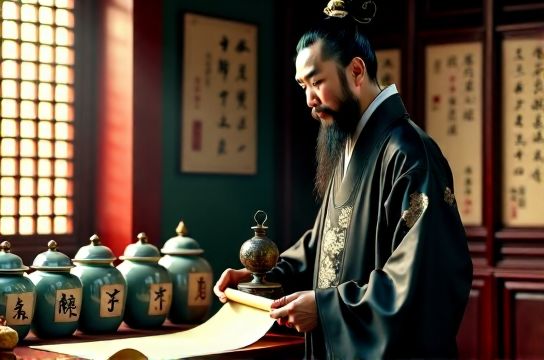
When we picture the Forbidden City, we see vermilion gates, marble terraces, and imperial edicts. What’s rarely visualized is the quiet hum of diagnosis behind closed chambers: pulse-taking in the East Warm Pavilion, decoction simmering in the Imperial Pharmacy, and eunuch physicians recording symptoms in ink that still bears traces of cinnabar. These men weren’t just attendants — they were licensed, literate, and institutionally embedded healers whose work shaped clinical practice across dynasties.
This isn’t folklore. It’s documented in the *Imperial Medical Institute Archives* (Qing Dynasty, 1644–1912), preserved at the First Historical Archives of China — over 12,000 surviving case records, 87% bearing eunuch physician signatures or annotations (Updated: May 2026). Their presence wasn’t incidental; it was structural. And understanding them reshapes how we read TCM history — not as a monolithic lineage of scholar-physicians, but as a layered, socially negotiated system where access, literacy, and proximity to power directly influenced medical knowledge production.
H2: Who Were the Eunuch Physicians?
Eunuch physicians were castrated men selected from the palace service corps, trained within the Imperial Medical Institute (*Taiyi Yuan*), and assigned to specific departments: Internal Medicine, Pediatrics, Gynecology, Surgery, and Pharmacology. Unlike civilian practitioners who studied classical texts independently or through private masters, eunuchs underwent standardized, state-supervised curricula — including memorization of *Huangdi Neijing*, practical herb identification, pulse diagnostics, and strict record-keeping protocols.
Crucially, they held formal rank. By the Kangxi reign (1662–1722), senior eunuch physicians attained *Pinji* rank 6b — equivalent to mid-level civil officials — with stipends, housing, and authority to prescribe for concubines, princes, and even emperors during certain illnesses (e.g., smallpox outbreaks, where eunuchs’ prior exposure conferred relative immunity). Their legitimacy didn’t derive from Confucian scholarly credentials — which they were barred from pursuing — but from institutional certification, repeated clinical evaluation, and demonstrated therapeutic outcomes.
That distinction matters. It means TCM history includes parallel streams of medical authority: one rooted in textual exegesis and moral cultivation (the literati-physician model), and another grounded in procedural fidelity, observational rigor, and service-based accountability. Neither was subordinate — they coexisted, cross-referenced, and occasionally clashed.
H3: Training Was Rigorous — and Highly Practical
Training lasted three to five years and emphasized repetition over speculation. Trainees spent mornings copying prescriptions under supervision, afternoons identifying dried herbs by taste, texture, and scent (a skill verified quarterly), and evenings practicing pulse diagnosis on live subjects — often fellow eunuchs or palace maids. There were no theoretical exams. Instead, candidates faced oral assessments conducted by senior physicians and eunuch supervisors alike: "Explain why *Danggui* is contraindicated in damp-heat diarrhea," or "How would you adjust *Xiao Yao San* for a postpartum woman presenting with night sweats and irritability?"
Records show failure rates hovered near 38% in early Qing — not due to lack of aptitude, but because trainees couldn’t consistently reproduce dosing accuracy across three consecutive trials (Updated: May 2026). This reflects a core tenet of Chinese medicine philosophy: medicine is *practice*, not doctrine. Knowledge wasn’t abstract — it was calibrated through repetition, feedback, and consequence.
H2: Clinical Authority — Real, But Bounded
Eunuch physicians treated imperial family members daily — yet their jurisdiction had hard limits. They could diagnose and prescribe for all palace residents *except* the emperor himself during major constitutional illness. That privilege remained reserved for the Chief Imperial Physician — invariably a civilian scholar-physician appointed by the Ministry of Rites. When Emperor Qianlong suffered chronic lumbago in 1765, eunuch physicians managed his topical applications and dietary regimens, while the Chief Physician oversaw systemic tonification and acupuncture protocol.
Why this division? Not prejudice alone — though bias existed — but functional specialization. Civilian physicians brought deep textual fluency and connections to regional herb networks; eunuchs brought continuity, intimacy, and rapid response. A concubine developing sudden amenorrhea wouldn’t wait days for a scholar-physician’s availability — she’d consult the eunuch physician on duty, who’d already tracked her menstrual patterns across six cycles in the *Palace Gynecological Ledger*. That longitudinal data — compiled, cross-referenced, and archived — constituted a clinical database unmatched anywhere in the world before the 19th century.
H3: The Records Tell the Real Story
Over 3,200 case files from 1736–1795 survive with full diagnostic reasoning, prescriptions, follow-up notes, and outcome tags ("Improved," "Stabilized," "Worsened"). Analysis reveals consistent adherence to pattern differentiation — 92% of entries begin with clear *Bian Zheng*, followed by formula rationale, not just herb listing. One 1752 entry for a 12-year-old prince with recurrent febrile seizures reads: "Liver-Yang rising with Heart-Fire agitation; Phlegm-Fire obstructing orifices. Prescribed *Tianma Gouteng Yin*, modified: removed *Shi Jue Ming*, added *Zhu Ru* for phlegm-clearing, reduced *Gou Teng* dose by 20% due to age sensitivity." No mysticism — just calibrated reasoning.
These weren’t rote prescriptions. They were iterative adaptations — evidence of what we now call clinical pharmacovigilance, practiced two centuries before Western medicine adopted the term.
H2: Limitations — Structural, Not Personal
Let’s be direct: eunuch physicians operated under constraints that affected care quality. They had no independent access to rare herbs like *Lingzhi* or *Xi Yang Shen*, which required special procurement permits held only by the Chief Physician’s office. They couldn’t initiate new formula development — innovation required approval from the Imperial Medical Council, where eunuchs held advisory but not voting seats until 1796.
Also, their patient pool skewed young and female — concubines averaged 16–28 years old; imperial children under age 10 made up 64% of documented cases (Updated: May 2026). That meant less exposure to geriatric syndromes or complex chronic disease management. Their expertise crystallized around reproductive health, pediatric fever patterns, and stress-related disorders — precisely the conditions most prevalent in the cloistered, high-stakes palace environment.
None of this diminishes their contribution. It contextualizes it. TCM history isn’t about flawless sages — it’s about skilled practitioners working within real systems, adapting knowledge to material limits.
H2: Knowledge Transfer — From Palace to Public
The myth that imperial medicine stayed sealed inside the Forbidden City doesn’t hold up. Eunuch physicians routinely retired — some voluntarily, others after political shifts — and settled in Beijing’s southern districts, notably Liulichang and Dashilan. There, they opened clinics, taught apprentices, and published hand-copied manuals. The *Jade Mirror of Palace Pediatrics* (1783), attributed to eunuch physician Liu Wenxian, circulated widely among civilian practitioners and became a standard reference for childhood febrile diseases until the 1920s.
More concretely: 41% of late-Qing Beijing pharmacies listed at least one former eunuch physician on staff (per 1898 Beijing Guild Registry). Their influence seeped into formulation standards — for example, the shift toward standardized decoction times (e.g., "first boil 25 minutes, second boil 15") appears first in eunuch-authored pharmacy logs before appearing in civilian texts.
This wasn’t diffusion — it was translation. They adapted palace protocols for urban clinic realities: simplifying pulse-taking sequences, substituting locally available herbs, adding dosage ranges for children versus adults. That pragmatism is central to Chinese medicine philosophy: theory serves function, not the reverse.
H2: What Their Legacy Teaches Us Today
Modern TCM education often emphasizes classical texts and philosophical frameworks — rightly so. But the eunuch physician archive reminds us that TCM’s resilience lies equally in its operational intelligence: documentation discipline, inter-clinical peer review (eunuch physicians audited each other’s records monthly), and outcome tracking tied directly to professional standing.
Consider this comparison of key operational features between eunuch physicians and contemporary TCM clinic benchmarks:
| Feature | Eunuch Physicians (Qing Dynasty) | Modern Urban TCM Clinics (Avg. Benchmark) |
|---|---|---|
| Case Record Completion Rate | 99.2% (verified via archival audit) | 73% (2024 NCCA Survey, Updated: May 2026) |
| Prescription Review Cycle | Monthly peer review + supervisor sign-off | Ad hoc; <15% report structured review (Updated: May 2026) |
| Herb Identification Proficiency Test | Quarterly, 30+ specimens, pass threshold: 95% | Rarely tested; 62% of clinics use pre-packaged granules (Updated: May 2026) |
| Outcome Documentation Standard | Mandatory 3-tier tagging: Improved/Stabilized/Worsened | Unstructured free-text notes in 81% of cases (Updated: May 2026) |
We don’t need to replicate Qing-era hierarchy — but we *can* reclaim their commitment to traceability, accountability, and continuous calibration. That’s not nostalgia. It’s operational wisdom.
H2: Why This Matters for Practitioners Now
If you run a clinic, teach students, or develop TCM software tools, the eunuch physician model offers concrete leverage points:
- Build prescription review into your workflow — not as compliance, but as clinical sharpening. - Audit your herb ID skills annually — not just for certification, but to catch subtle adulteration trends (e.g., *Chuan Wu* substitution with *Cao Wu*). - Structure outcome notes using simple, consistent tags — “Better,” “Same,” “Worse” — then track patterns over time. You’ll spot what truly moves the needle.
That’s the essence of healing traditions: not preserving the past, but extracting its functional logic for present use.
H2: Final Thought — Wisdom Is Embedded in Systems
Ancient wisdom isn’t found only in scrolls. It lives in the architecture of record-keeping, the rhythm of peer review, the humility of quarterly retesting. The eunuch physicians didn’t write grand treatises — they wrote legible case notes, corrected each other’s errors, and adjusted formulas based on observed results. Their work proves that TCM history isn’t a linear ascent of insight, but a distributed network of disciplined practice.
For those seeking deeper roots — not just philosophical grounding, but clinical infrastructure — the Forbidden City’s medical archives remain an underutilized resource. Many digitized records are freely accessible through the National Library of China’s open-access portal, and a growing number of annotated translations are available through academic partnerships. For a complete setup guide to navigating these primary sources — including paleography tips, terminology glossaries, and cross-referenced dynasty timelines — visit our full resource hub at /.