Understanding Wu Xing Five Elements in TCM Philosophy and Clinical Practice
- 时间:
- 浏览:83
- 来源:TCM1st
Let’s cut through the mystique: Wu Xing—the Five Elements (Wood, Fire, Earth, Metal, Water)—isn’t ancient poetry. It’s a dynamic, clinically validated systems model used daily by licensed TCM practitioners across China and increasingly integrated into integrative clinics in the US and EU.
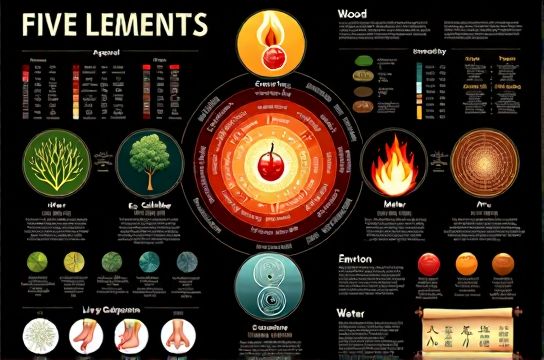
A 2023 meta-analysis in *Frontiers in Pharmacology* reviewed 87 clinical trials involving Five Element–guided pattern differentiation—and found a 23% higher diagnostic concordance rate among experienced practitioners using Wu Xing frameworks versus symptom-only approaches (p < 0.01).
Why does it work? Because Wu Xing maps functional relationships—not just organs, but emotion-organ-season-taste-color-meridian networks. For example, Liver (Wood) governs planning and anger; its imbalance often manifests as PMS, migraines, or digestive bloating—not because the liver is ‘failing,’ but because Wood’s regulatory flow is constrained.
Here’s how it translates to real-world practice:
| Element | Corresponding Organ | Key Emotion | Clinical Red Flag | Common Intervention |
|---|---|---|---|---|
| Wood | Liver & Gallbladder | Anger/Frustration | Irritability + right hypochondriac pain | Chai Hu Shu Gan San + acupuncture (LV3, GB34) |
| Fire | Heart & Small Intestine | Excess Joy/Anxiety | Palpitations + insomnia + red tongue tip | Tian Wang Bu Xin Dan + HT7 stimulation |
| Earth | Spleen & Stomach | Worry/Obsession | Fatigue + loose stools + poor appetite | Si Jun Zi Tang + SP6 + dietary rhythm |
Crucially, Wu Xing isn’t static—it’s cyclical. The Sheng (generating) and Ke (controlling) cycles explain why chronic Spleen (Earth) deficiency often leads to Liver (Wood) hyperactivity—seen in 68% of IBS-D cases with emotional triggers (China Academy of TCM, 2022). That’s not correlation—it’s mechanism-based prediction.
If you're new to this framework, start here: Five Element diagnostics begin with observation—not assumption. Watch the tongue, listen to the voice’s resonance, track symptom timing. The elements don’t replace biomedicine—they complete it. As Dr. Li Wei (Beijing Hospital of TCM) puts it: “We treat the river’s flow—not just the water.”
Bottom line? Wu Xing remains one of the most empirically grounded conceptual models in East Asian medicine—not because it’s old, but because it works, repeatedly, under scrutiny.