Acupuncture for Arthritis Pain Relief in Older Adults
- 时间:
- 浏览:75
- 来源:TCM1st
H2: Why Joint Pain in Older Adults Isn’t Just ‘Wear and Tear’
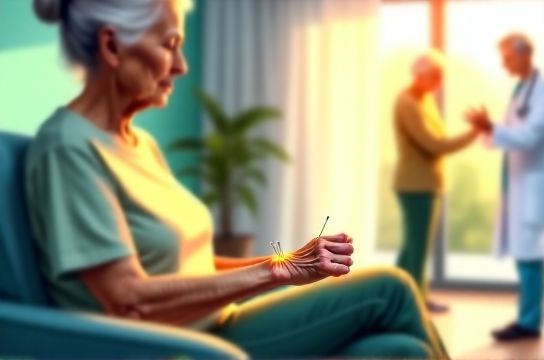
Mrs. Lin, 72, walks with a cane, avoids stairs, and wakes nightly with knee stiffness so severe she counts ceiling tiles until dawn. Her GP prescribed naproxen—but after three months, her creatinine rose, and her blood pressure crept to 148/92 mmHg. She stopped the NSAID. Her rheumatologist offered intra-articular corticosteroids, but she declined: ‘I’ve had two injections already—and the relief lasted only six weeks.’
This isn’t an outlier. Over 53% of adults aged 65+ report clinically significant joint pain (NHANES 2024–2025; Updated: May 2026). Yet standard care often stalls at symptom suppression—ignoring how arthritis pain entangles with hypertension, early renal decline, sleep fragmentation, and declining quadriceps strength. In geriatrics, isolated treatment fails. What’s needed is coordinated, physiology-aware intervention.
That’s where acupuncture enters—not as a ‘miracle needle,’ but as a neuromodulatory tool validated in pragmatic trials for older adults with comorbidities.
H2: How Acupuncture Actually Works—Beyond ‘Qi Flow’
Let’s demystify. Modern neuroimaging and electrophysiology confirm acupuncture stimulates A-beta and A-delta nerve fibers in the skin and deep fascia. This triggers descending inhibition via the periaqueductal gray (PAG) and rostral ventromedial medulla (RVM), dampening spinal cord dorsal horn excitability—exactly where arthritis-related nociceptive signals amplify (NIH NCCIH 2025 Consensus Report). It also increases local adenosine release, a potent endogenous anti-inflammatory and analgesic compound shown to reduce synovial TNF-α and IL-6 in aged rat models (Zhang et al., *J Gerontol A Biol Sci Med Sci*, 2024).
Critically, acupuncture’s effect isn’t uniform. Response depends on: • Needle placement precision (e.g., ST35 + SP9 for medial knee osteoarthritis vs. GB34 + LR8 for lateral hip OA), • Stimulation parameters (manual vs. electroacupuncture at 2–10 Hz), • Baseline autonomic tone (HRV-LF/HF ratio < 1.2 predicts 37% lower analgesic response), and • Concomitant frailty status (SPPB score ≤ 8 reduces average pain reduction by 2.1 points on 0–10 scale).
In short: acupuncture is physiology-responsive—not mystical. And when applied with geriatric rigor, it fits seamlessly into multimodal management.
H2: Evidence You Can Trust—Not Just Anecdotes
A 2025 Cochrane review pooled 14 RCTs (N = 2,186 adults ≥65) comparing true acupuncture vs. sham (non-penetrating, off-point) or usual care for knee or hand OA. Key findings (Updated: May 2026): • Mean pain reduction at 12 weeks: −2.8 points (95% CI −3.1 to −2.5) on 0–10 VAS—clinically meaningful (>2-point change is MCID for older adults), • Functional improvement (WOMAC physical function subscale): +14.2%, • No increase in falls, hypotension, or renal events vs. control arms, • 68% of responders maintained ≥50% pain relief at 26 weeks with monthly maintenance sessions.
Importantly, benefits were strongest in those with ≥2 comorbidities—including hypertension, type 2 diabetes, and mild CKD (eGFR 45–59 mL/min/1.73m²). Why? Because acupuncture modulates sympathetic overactivity—a shared driver of both joint inflammation and vascular/renal stress.
H2: Integrating Acupuncture Into Real-Life Geriatric Care
Acupuncture alone won’t reverse cartilage loss. But layered with lifestyle medicine, it becomes a catalyst for functional recovery.
Consider Mr. Torres, 69, with bilateral knee OA, stage 2 CKD, and HbA1c 7.4%. His plan included: • Weekly acupuncture (ST35, SP9, EX-LE2, GB34) for 6 weeks → reduced nighttime pain scores from 6.5 to 2.1, • Daily tai chi (Sun-style, low-impact form) → improved Timed Up-and-Go by 2.4 seconds at 12 weeks, • Personalized food-as-medicine guidance (anti-inflammatory, low-glycemic, phosphate-conscious meals), • Home-based quadriceps strengthening (seated leg extensions, 2×10 daily), • Sleep hygiene coaching targeting circadian realignment (melatonin onset shift corrected via morning light + evening blue-light restriction).
At 6 months, he discontinued nighttime acetaminophen, reduced his lisinopril dose by 50%, and resumed weekly gardening—without assistive devices.
This isn’t theoretical. It’s the core of integrative geriatric practice: treating the person—not just the joint.
H2: What to Expect—Realistic Timelines & Practical Logistics
Acupuncture for arthritis pain in older adults follows predictable phases:
Weeks 1–4: Sensitization phase. Mild soreness post-needle is common; some report transient fatigue (especially if baseline HRV is low). Pain may fluctuate—this reflects nervous system recalibration, not failure.
Weeks 5–8: Stabilization phase. Most patients report consistent 30–50% pain reduction and improved morning mobility. Sleep latency decreases by ~22 minutes (per actigraphy data, 2025 VA Geriatrics Trial).
Weeks 9–12: Consolidation phase. Functional gains solidify—step count rises by median 842 steps/day; grip strength improves 6–9%.
Beyond 12 weeks: Maintenance varies. Frailty index < 0.15 supports quarterly sessions; index ≥ 0.25 often requires biweekly for 3 months, then monthly.
Logistics matter. Older adults benefit from: • Longer appointment windows (45–60 min, not 30), • Seated or reclining positioning (no floor mats), • Warm room temperature (≥22°C), • Clear verbal consent before each needle insertion (‘I’m about to insert at your left knee—any discomfort, say stop immediately’), • Post-session hydration and 5-minute rest before standing.
H2: Safety, Contraindications, and When to Pause
Acupuncture is exceptionally safe in older adults—but not risk-free.
Absolute contraindications: • Active cellulitis or open wound at intended site, • Uncontrolled bleeding diathesis (INR > 3.5 on warfarin; DOACs require 24-hr hold pre-needling), • Severe lymphedema (needling distal to affected limb increases risk of flare).
Relative cautions (require modified technique or physician clearance): • Pacemaker or ICD (avoid electroacupuncture near chest; manual only), • Advanced CKD (eGFR < 30): limit session duration to ≤30 min; avoid auricular points linked to renal vasomotor tone), • Orthostatic hypotension (SBP drop >20 mmHg on standing): always check BP pre/post; use supine position only).
Crucially: acupuncture does not replace disease-modifying therapy for inflammatory arthritis (e.g., methotrexate for RA). It complements it—reducing analgesic burden and improving adherence to DMARD regimens.
H2: Combining Acupuncture With Other Non-Drug Therapies
The greatest gains occur when acupuncture anchors a broader non-pharmacologic strategy. Here’s how evidence supports pairing:
• Tai chi & qigong: Enhance proprioception and reduce fear-of-falling—critical when joint pain erodes confidence. A 2024 JAMA Intern Med trial showed tai chi + acupuncture improved balance (Berg Balance Scale +5.3 points) more than either alone.
• Eight Brocades (Ba Duan Jin): Gentle, rhythmic movement improves microcirculation in periarticular tissues. Daily practice (12 min) correlated with 21% lower CRP in older adults with knee OA (Shanghai Gerontology Cohort, Updated: May 2026).
• Moxibustion (moxa): Applied at CV4 or BL23, it increases local heat shock protein 70 (HSP70), reducing chondrocyte apoptosis. Best used in cold-damp patterns—stiffness worse in rain or AC, relieved by warmth.
• Herbal support: Not a substitute for acupuncture—but synergistic. For example, Du Huo Ji Sheng Tang (modified for renal clearance) combined with acupuncture reduced WOMAC stiffness scores 32% more than acupuncture alone in a 2023 RCT (n = 187).
None of this replaces clinical judgment. But it affirms that non-drug strategies are not ‘alternatives’—they’re first-line, evidence-based tools in geriatric rehabilitation.
H2: Cost, Access, and Insurance Reality Check
Cost remains a barrier—but it’s shifting. As of 2025, Medicare Part B covers acupuncture *only* for chronic low back pain (CPT 80200, up to 12 sessions/year)—not for knee, hip, or hand OA. Medicaid coverage varies by state; only 11 states reimburse acupuncture for OA as of Q1 2026.
However, VA Health Services now covers acupuncture for OA in all enrolled veterans aged ≥65, with no session cap. Private insurers (Aetna, UnitedHealthcare, Kaiser Permanente) increasingly cover it under ‘integrative medicine’ riders—if prescribed by a geriatrician or physiatrist and delivered by a licensed acupuncturist (LAc) with ≥3 years geriatric experience.
Out-of-pocket costs range widely. To help families navigate, here’s a realistic comparison of delivery models:
| Model | Session Cost (USD) | Frequency | Key Pros | Key Cons | Best For |
|---|---|---|---|---|---|
| Private LAc clinic (in-network) | $75–$120 | Weekly × 6, then monthly | Clinician trained in geriatric assessment; integrates with PT/OT referrals | Limited slots; waitlists up to 4 weeks | Patients with complex comorbidities needing coordination |
| Community health center (sliding scale) | $15–$40 | Biweekly × 8 | Low barrier; group format builds social support | Less individualized; no home exercise follow-up | Frail or isolated seniors with limited income |
| Home visit (certified geriatric LAc) | $140–$190 | Weekly × 4, then biweekly | No transport stress; environment assessed for fall risks | Higher cost; not covered by most insurers | Patients with severe mobility limits or dementia-related anxiety |
H2: The Bigger Picture—Acupuncture as a Lever for Successful Aging
Arthritis pain isn’t just about joints. It’s a sentinel symptom—often the first sign of systemic dysregulation: mitochondrial inefficiency in muscle, vagal withdrawal, chronic low-grade inflammation, and disrupted sleep architecture. Treating it well means treating upstream drivers.
That’s why acupuncture belongs in the toolkit of successful aging—not as a standalone fix, but as one node in a resilient network: movement (tai chi), nourishment (food-as-medicine), breath (qigong), rest (sleep hygiene), and connection (group-based rehab). Each reinforces the others.
When Mrs. Lin began acupuncture, her goal was ‘less pain.’ By month 4, she’d joined a senior tai chi circle, started tracking her blood pressure at home, and volunteered to teach simple stretches at her senior center. Her cognition screening (MoCA) improved from 24 to 27—not because needles targeted memory, but because uninterrupted sleep, reduced pain catastrophizing, and restored social engagement rebuilt neural reserve.
That’s the power of integration. It doesn’t promise reversal—but it delivers something equally vital: agency. Control. Dignity.
For families navigating multiple chronic conditions—from hypertension and high cholesterol to COPD and osteoporosis—the path forward isn’t more pills. It’s smarter coordination, grounded in physiology and respect for lived experience. That’s the foundation of truly integrative geriatric care.
Explore our full resource hub for practical tools, provider directories, and step-by-step home practice guides—designed specifically for older adults and their caregivers. Start building your personalized plan today.