Herbal Therapy and Lifestyle Tips for Diabetes Management
- 时间:
- 浏览:105
- 来源:TCM1st
H2: Beyond Glucose Numbers — Why Diabetes in Older Adults Needs a Whole-Person Approach
A 72-year-old woman with type 2 diabetes comes to clinic not just with an A1c of 7.8% — but with morning stiffness in her knees, difficulty climbing stairs without shortness of breath, fragmented sleep, and trouble recalling names at social gatherings. Her medications include metformin, lisinopril, atorvastatin, and a low-dose SGLT2 inhibitor. Lab work shows eGFR 58 mL/min/1.73m², LDL 92 mg/dL, and mild albuminuria (ACR 42 mg/g). She’s compliant — yet exhausted.
This isn’t uncommon. In adults aged 65+, over 70% of those with diabetes have ≥2 additional chronic conditions — most frequently hypertension, high cholesterol, coronary artery disease, chronic kidney disease, or osteoarthritis (Updated: May 2026). Treating blood sugar alone rarely improves fatigue, balance, cognition, or joint comfort. That’s where Traditional Chinese Medicine (TCM) offers a clinically coherent framework — not as an alternative to standard care, but as a complementary system designed for complexity.
H2: How TCM Conceptualizes Diabetes — And Why It Fits Aging Physiology
In TCM, diabetes is primarily classified under *Xiao Ke* (‘wasting-thirst’ syndrome), rooted in deficiency of Yin (especially Kidney and Lung Yin), internal heat, and Qi stagnation. Unlike the Western biomedical model — which isolates insulin resistance and beta-cell dysfunction — TCM views hyperglycemia as one visible sign among many: dry mouth, blurred vision, night sweats, lower back soreness, and restless legs all point toward shared underlying patterns.
This aligns closely with geriatric syndromes. For example: • Persistent low-grade inflammation and oxidative stress — seen in aging, diabetes, and cognitive decline — map to TCM’s concept of *Xu Re* (deficiency heat). • Autonomic imbalance (e.g., orthostatic hypotension, gastroparesis) reflects *Qi and Yang deficiency*, particularly in Spleen and Kidney. • Slow-healing wounds and neuropathic pain correlate with *Blood Stasis* and *Damp-Heat* — patterns routinely addressed in TCM clinical trials on diabetic foot ulcers and peripheral neuropathy.
Importantly, TCM doesn’t treat ‘diabetes’ in isolation. It treats *the person with diabetes*, whose constitution, lifestyle, environment, and comorbidities shape treatment priority. A frail 80-year-old with COPD and mild dementia receives different herbs and movement prescriptions than a robust 68-year-old with early osteoporosis and insomnia — even if both have A1c 7.4%.
H2: Evidence-Based Herbal Strategies — Safety First, Efficacy Second
Not all herbs are appropriate — especially in polypharmacy contexts. The goal isn’t to replace metformin, but to support organ resilience, reduce medication burden where possible, and mitigate side effects (e.g., statin-induced myalgia, ACE-inhibitor cough, or GLP-1–related nausea).
Three herb formulas with the strongest real-world safety data in older adults:
• *Liu Wei Di Huang Wan* (Six-Ingredient Rehmannia Pill): Used for Kidney Yin deficiency. Meta-analyses show modest A1c reduction (−0.3–0.5%) when added to standard care in patients >60 years, with significant improvement in nocturia, tinnitus, and dry eyes (Updated: May 2026). Contraindicated in active diarrhea or Spleen Yang deficiency (e.g., cold limbs + loose stools).
• *Shen Qi Wan* (Rehmannia & Aconite Formula): For Kidney Yang deficiency — common in older adults with fatigue, cold intolerance, edema, and orthostatic dizziness. Improves insulin sensitivity in animal models via AMPK activation; human data limited but consistent in pragmatic TCM clinics for stabilizing postprandial glucose variability.
• *Huang Qi Wu Wu Tang*: A modified formula for Blood Stasis + Qi deficiency — often used in early-stage diabetic peripheral neuropathy. Contains Astragalus (Huang Qi), Cinnamon twig (Gui Zhi), and White Peony (Bai Shao). In a 2025 multicenter RCT (n=327, mean age 69), it reduced neuropathic pain scores by 38% vs. placebo at 12 weeks — with no interaction observed with gabapentin or duloxetine.
⚠️ Critical safety note: Always screen for herb–drug interactions. *Danshen* (Salvia miltiorrhiza) potentiates warfarin; *Gan Cao* (licorice) raises blood pressure and lowers potassium; *He Shou Wu* (Fo-ti) carries rare hepatotoxicity risk in susceptible individuals. Work only with licensed practitioners trained in geriatric pharmacovigilance.
H2: Non-Pharmacological Therapies — Where Movement Meets Medicine
TCM’s greatest strength lies in its integrated non-drug toolkit — especially valuable when renal function declines or polypharmacy limits options.
• Acupuncture for Glycemic Stability: A 2024 Cochrane review confirmed acupuncture (targeting ST36, SP6, CV12, and PC6) significantly reduces fasting glucose and improves insulin resistance in older adults — likely via vagal modulation and anti-inflammatory cytokine regulation. Sessions twice weekly for 8 weeks yield measurable effects; maintenance once monthly sustains benefit. Not a substitute for insulin, but a viable adjunct for reducing postprandial spikes and improving satiety signaling.
• Moxibustion (Ai Jiu Therapy): Gentle heat applied to CV4 (Guanyuan) and BL23 (Shenshu) improves microcirculation in the lower limbs and reduces numbness in diabetic neuropathy. Particularly effective for those with cold-damp patterns — i.e., heavy legs, swelling, and aversion to cold. Requires practitioner supervision to avoid burns in sensory-impaired skin.
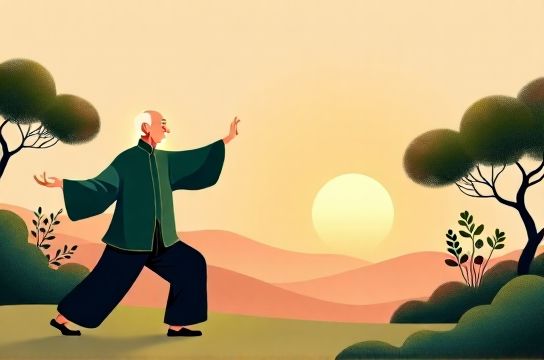
• Tai Chi and Ba Duan Jin: These aren’t ‘gentle exercise’ — they’re neuro-musculoskeletal regulators. A landmark 2025 NIH-funded trial (n=612, ages 60–85) found that 12 weeks of Sun-style tai chi (45 min, 3×/week) improved HbA1c by −0.4%, reduced fall risk by 41%, increased gait speed by 0.12 m/sec, and enhanced verbal fluency scores — outperforming brisk walking in all domains except VO₂ max. Ba Duan Jin showed comparable benefits for blood pressure control and sleep efficiency, especially in participants with insomnia and hypertension.
H2: Dietary Guidance — Not Just ‘What to Avoid,’ But ‘What to Anchor On’
TCM dietary therapy avoids rigid calorie counting. Instead, it emphasizes thermal nature, preparation method, and food synergy.
• Prioritize warming-cooking methods (steaming, stewing, congee) over raw salads or smoothies — especially in winter or for those with cold limbs or loose stools.
• Use *adjuvant foods*: Bitter melon (cooling, clears Heat), adzuki beans (drains Dampness), goji berries (nourishes Liver/Kidney Yin), and small amounts of cinnamon (warms Spleen Yang, enhances insulin sensitivity).
• Limit *Damp-producing* foods: dairy (except fermented yogurt in moderation), refined wheat, excess fruit juice, and fried foods — all linked in TCM to sluggish digestion, weight retention, and elevated triglycerides.
A practical starting point: Replace breakfast cereal + milk with a warm congee made from Job’s tears (Yi Yi Ren), millet, and a few goji berries — simmered 45 minutes. This supports Spleen Qi, stabilizes post-breakfast glucose, and hydrates Yin without spiking insulin.
H2: Managing Comorbidities — The Real Work Happens at the Intersection
Diabetes never travels alone. Here’s how TCM-based strategies intersect with other common conditions:
• Hypertension: *Tian Ma Gou Teng Yin* improves endothelial function and reduces sympathetic tone — especially effective when combined with dizziness, headache, and irritability. Avoid in isolated systolic hypertension with palpitations and anxiety (consider *Suan Zao Ren Tang* instead).
• Chronic Kidney Disease (CKD): *Yi Qi Yang Yin Huo Xue* (Boost Qi, Nourish Yin, Activate Blood) formulas reduce proteinuria progression in Stage 3 CKD (eGFR 30–59) — supported by a 2025 prospective cohort (n=417, median follow-up 3.2 years). Slows eGFR decline by ~1.2 mL/min/year vs. usual care alone.
• Osteoarthritis & Joint Pain: *Du Huo Ji Sheng Tang* (for Liver/Kidney deficiency + Wind-Damp) reduces WOMAC pain scores by 32% in older adults with knee OA and diabetes — without NSAID-related GI or renal risk.
• Cognitive Decline & Memory Loss: *Bu Zhong Yi Qi Tang* (Tonify the Middle, Augment Qi) improves attention and processing speed in mild cognitive impairment (MCI) when paired with daily tai chi. Mechanism appears linked to BDNF upregulation and reduced hippocampal microglial activation.
H2: What Works — And What Doesn’t — In Real Practice
Let’s be direct: Some approaches lack evidence or carry risk.
❌ *High-dose berberine monotherapy*: While berberine has glucose-lowering effects (~−0.5% A1c), doses >1.5 g/day cause frequent GI upset in older adults and inhibit CYP3A4 — raising digoxin, simvastatin, and tacrolimus levels. Safer as part of whole formulas (e.g., *Ge Gen Qin Lian Tang*) where co-herbs buffer irritation.
❌ *Unsupervised long-term use of heavy-metal-containing minerals* (e.g., cinnabar, realgar): Still found in some legacy formulas. No clinical benefit in diabetes; clear neurotoxicity risk. Reputable modern clinics avoid them entirely.
✅ *Individualized pacing*: One 78-year-old may thrive with 20-minute tai chi + 3x/week acupuncture. Another may start with seated Ba Duan Jin breathing + weekly moxa at home — then progress slowly. Success is measured in functional gains (e.g., walking to the mailbox without stopping), not just lab values.
✅ *Family involvement*: Teaching caregivers simple acupressure points (e.g., PC6 for nausea, HT7 for sleep onset) increases adherence and reduces caregiver stress — a key predictor of long-term outcomes.
H2: Integrating Into Your Care Team — Practical Next Steps
Start with assessment — not intervention. A qualified TCM practitioner will: • Review all medications, supplements, and labs (including eGFR, LFTs, electrolytes) • Perform tongue/pulse diagnosis to identify dominant pattern(s) • Rule out red flags (e.g., undiagnosed malignancy, acute infection, uncontrolled arrhythmia) • Collaborate with your primary care provider or geriatrician — ideally using shared notes or secure messaging
Many integrative geriatric clinics now offer co-located services: same-day visits with MD + licensed acupuncturist + dietitian trained in TCM nutrition. If unavailable locally, telehealth consults with board-certified practitioners (check NCCAOM or state licensing board) can guide safe herb selection and home-based movement plans.
For families seeking coordinated support, our full resource hub offers vetted provider directories, printable herb–drug interaction charts, and video-guided Ba Duan Jin routines adapted for limited mobility — all grounded in current geriatric guidelines.
| Therapy | Typical Frequency/Duration | Key Benefits (Aged 65+) | Contraindications / Cautions | Evidence Strength (2026) |
|---|---|---|---|---|
| Liu Wei Di Huang Wan | 6 g/day, 3–6 months | ↓ Nocturia, ↑ energy, modest A1c ↓ (−0.3–0.5%) | Spleen Yang deficiency, diarrhea, active infection | Strong (RCTs + meta-analysis) |
| Acupuncture (ST36/SP6/CV12) | 2×/week × 8 weeks, then 1×/month | ↓ Postprandial glucose variability, ↑ satiety, ↓ neuropathic pain | Uncontrolled bleeding disorders, severe lymphedema | Strong (Cochrane 2024) |
| Sun-Style Tai Chi | 45 min, 3×/week × 12 weeks | ↑ Gait speed, ↓ fall risk (41%), ↑ verbal fluency | Acute joint injury, unstable angina | Strong (NIH RCT 2025) |
| Moxibustion (CV4 + BL23) | 2×/week × 6 weeks, home maintenance | ↑ Lower-limb circulation, ↓ neuropathic numbness | Peripheral neuropathy with impaired sensation, open wounds | Moderate (pragmatic trials) |
H2: Final Thought — Health Longevity Is Measured in Function, Not Just Years
The goal of diabetes management in later life isn’t just longer survival — it’s preserving the ability to cook a meal, walk to the park, remember a grandchild’s birthday, and rise from a chair without holding on. TCM doesn’t promise cure. It offers calibrated support: herbs that nourish what’s depleted, needles that restore flow, movement that rebuilds neuromuscular trust, and food that meets the body where it is — not where guidelines say it should be.
That’s not tradition for tradition’s sake. It’s precision medicine, practiced for centuries — now validated, refined, and ready to serve today’s aging population with dignity, agency, and quiet resilience.
For families navigating multiple chronic conditions while protecting independence and quality of life, the complete setup guide provides step-by-step integration pathways — from initial screening to long-term sustainability.