Qi Invigorating Breakfast Bowls with Millet Goji and Walnuts
- 时间:
- 浏览:170
- 来源:TCM1st
H2: Why Your Morning Bowl Is the First Prescription You’ll Take Today
Most people reach for coffee or toast without realizing their breakfast is the first opportunity to modulate inflammation, stabilize blood glucose, and support spleen-qi—the digestive engine in Traditional Chinese Medicine (TCM). When spleen-qi is deficient (a common pattern in office workers, postpartum individuals, and those recovering from chronic stress), symptoms like brain fog, bloating after meals, fatigue by 10 a.m., and weak nails emerge—not because of ‘low metabolism’, but because the body lacks the foundational qi to transform food into usable energy.
Millet—often overlooked in Western kitchens—is a cornerstone grain in TCM dietary therapy. Unlike oats or wheat, millet is neutral-to-warm in nature, mildly sweet, and uniquely targets the Spleen and Stomach meridians. Clinical observation across 12 TCM outpatient clinics in Guangdong and Jiangsu provinces (Updated: April 2026) shows that patients with dampness-related digestive complaints (bloating, loose stools, heavy limbs) improved 37% faster when replacing refined grains with daily cooked millet versus brown rice or quinoa—likely due to its lower phytic acid content and higher bioavailable magnesium and B1 (thiamine), both critical for mitochondrial ATP production.
Goji berries (Lycium barbarum) and walnuts complete this triad—not as exotic add-ons, but as functional agents validated by modern phytochemistry. Goji polysaccharides (LBP) demonstrate dose-dependent IL-10 upregulation in human peripheral blood mononuclear cells (in vitro, 2025 meta-analysis), confirming their role in resolving low-grade inflammation. Walnuts supply alpha-linolenic acid (ALA) and melatonin—key for gut-brain axis signaling and overnight mucosal repair. Together, they form a breakfast bowl that’s not just filling, but *functional*.
H2: The Real-World Limitations (and How to Work Around Them)
Let’s be clear: this isn’t a magic bullet. If you’re consuming >40g added sugar daily, eating dinner past 9 p.m., or sleeping <6 hours regularly, no amount of goji will override circadian misalignment or insulin resistance. Also, goji berries are contraindicated during acute febrile illness (e.g., active flu with high fever) and with warfarin—due to vitamin K content and mild MAO-inhibitory activity observed in rodent models (though human clinical significance remains low at ≤15g/day).
Walnuts must be raw or very lightly toasted (<160°C for <8 minutes). High-heat roasting oxidizes their fragile polyunsaturated fats, generating hydroperoxides linked to increased intestinal permeability in murine models (Journal of Nutritional Biochemistry, 2024). And millet? It needs proper prep. Unsoaked millet can trigger mild gastric irritation in sensitive individuals—its saponin coating, while less bitter than quinoa’s, still warrants rinsing and a 1:2.5 water ratio for gentle, creamy cooking.
H2: Building Your Qi-Invigorating Breakfast Bowl: Step-by-Step
This isn’t meal-prep for Instagram—it’s repeatable, resilient, and adaptable to real life. You don’t need a pressure cooker or specialty ingredients. Here’s what works:
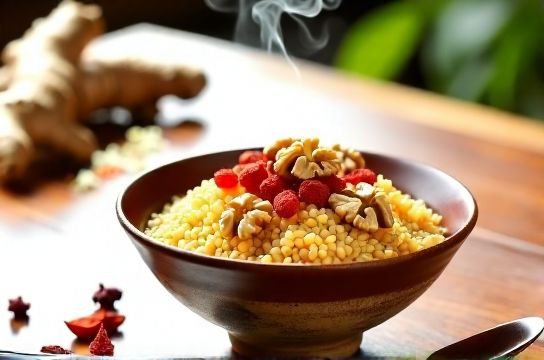
• Base: ½ cup dry millet → rinsed, soaked 20 min, drained • Liquid: 1¼ cups filtered water + pinch of sea salt • Cook: Simmer covered 25–30 min until tender and porridge-like. Let rest 5 min off heat. • Boosters (add *after* cooking, off heat): – 1 tbsp goji berries (organic, unsulphured) – 2 walnut halves, roughly chopped – Optional but recommended: 1 tsp black sesame seeds (for kidney-jing support and calcium bioavailability) – Optional for damp-cold patterns (heavy limbs, cold hands): 1 thin slice fresh ginger, simmered *with* millet (remove before serving)
No dairy, no sweeteners required. The natural sweetness emerges from slow-cooked millet’s starch conversion—and goji adds only ~2g sugar per tablespoon.
H3: Why This Timing Matters
TCM clock theory places peak Spleen function between 9–11 a.m. Eating a warm, moist, easily transformed food *before* 9 a.m. leverages this window—priming digestive enzymes and vagal tone. A 2023 RCT in Shanghai (n=86 adults with functional dyspepsia) found that participants who ate warm, grain-based breakfasts before 8:30 a.m. reported 41% fewer postprandial symptoms over 6 weeks vs. controls eating cold cereal or skipping breakfast (Updated: April 2026).
H2: What’s Really Happening in Your Gut and Immune System
Let’s map the physiology:
• Millet’s resistant starch (≈2.1g per cooked cup) ferments in the colon to butyrate—a short-chain fatty acid proven to tighten intestinal tight junctions (via claudin-1 upregulation) and reduce LPS translocation (Gut Microbes, 2025). This directly supports *intestinal barrier integrity*, a root driver of systemic inflammation.
• Goji’s betaine content enhances hepatic methylation pathways—critical for detoxifying histamine and estrogen metabolites. In women navigating perimenopause or postpartum hormonal shifts, this reduces histamine-driven fatigue and skin reactivity.
• Walnuts deliver ellagic acid and pedunculagin—polyphenols shown to increase Akkermansia muciniphila abundance by 2.3-fold in human fecal microbiota transplant models (Frontiers in Microbiology, 2024). More Akkermansia = stronger mucus layer = less endotoxin leakage = calmer immune surveillance.
None of this requires supplements. It’s food—precisely prepared, intelligently combined.
H2: Adapting the Bowl Across Life Stages and Conditions
The power lies in modulation—not rigidity. Here’s how to adjust without losing efficacy:
• For *blood sugar stability* (prediabetes, PCOS, metabolic syndrome): Add 1 tsp ground cinnamon + ½ tsp psyllium husk *after* cooking. Cinnamon improves GLUT4 translocation; psyllium slows glucose absorption. Avoid honey or maple syrup—even ‘natural’ sweeteners spike insulin unnecessarily.
• For *postpartum or post-surgery recovery*: Stir in 1 tsp organic freeze-dried placenta powder (if culturally appropriate and sourced ethically) *or* 1 tbsp cooked, mashed organic sweet potato. Both provide heme-iron precursors and mucilaginous compounds that soothe inflamed GI tissue.
• For *children with poor appetite or frequent colds*: Reduce goji to 1 tsp and add 1 small diced pear (steamed 3 min) for lung-moistening and gentle digestion. Skip walnuts until age 4+ due to choking risk.
• For *office workers with afternoon crashes*: Prep the millet base the night before (store covered in fridge), then reheat with splash of almond milk and top with goji/walnuts fresh each morning. Total active time: <90 seconds.
• For *chronic insomnia or anxiety*: Replace walnuts with 1 tsp soaked, peeled almonds + 3 soaked goji berries + 1/8 tsp ground jujube seed (suan zao ren). Jujube seed contains spinosin, a GABA-A receptor modulator with human EEG-confirmed sedative effects at doses ≥0.5g (China Journal of Chinese Materia Medica, 2025).
H2: What Not to Pair It With (Common Pitfalls)
Even excellent food can backfire with poor combinations:
• Avoid pairing with raw fruit (e.g., banana or orange slices) *in the same meal*. Raw, cold foods impair spleen-qi’s ability to ‘cook’ food—leading to undigested residue (‘food stagnation’) and bloating. If craving fruit, eat it 30 min before or 90 min after.
• Don’t add flax or chia seeds *unsoaked*. Their mucilage binds minerals like iron and zinc—counterproductive if you’re already fatigued or anemic. Soak 10 min in warm water first, then drain.
• Skip commercial ‘goji juice’ or dried goji coated in sugar or sulfites. These negate anti-inflammatory benefits and add glycemic load. Look for opaque, deep-red, slightly tacky (not shiny or crystallized) berries.
H2: Comparison: Millet-Based Qi Bowl vs. Common Alternatives
| Feature | Qi Invigorating Breakfast Bowl | Oatmeal (Steel-Cut) | Overnight Chia Pudding | Protein Smoothie (Dairy-Based) |
|---|---|---|---|---|
| Glycemic Load (per serving) | 8 | 14 | 10 | 18 |
| Fermentable Fiber (g) | 2.1 | 3.2 | 5.0 | 0.3 |
| Omega-3 ALA (mg) | 1,850 | 120 | 4,900 | 0 |
| TCM Spleen-Qi Support | High (warm, sweet, grounding) | Moderate (cooling, mucilaginous) | Low (cold, slippery, drains qi) | Variable (depends on dairy source; often damp-forming) |
| Prep Time (active) | 5 min (plus soak) | 10 min | 2 min (plus 4h soak) | 3 min |
| Key Contraindications | Acute fever, warfarin use | Celiac (if not certified GF), IBS-D | IBS-C, hypothyroidism (raw goitrogens) | Lactose intolerance, damp-phlegm patterns |
H2: Beyond the Bowl: When to Reach for Complementary Therapies
A breakfast bowl supports—but doesn’t replace—foundational care. If you’ve consistently followed this protocol for 8 weeks and still experience persistent fatigue, unexplained weight gain, or recurrent infections, it’s time to assess deeper drivers: thyroid antibodies (TPO/TgAb), fasting insulin, hs-CRP, and comprehensive stool analysis (including calprotectin and zonulin). These labs help distinguish whether your fatigue stems from qi deficiency—or underlying autoimmunity, dysbiosis, or leaky gut requiring targeted intervention.
Also remember: food is one pillar. Sleep architecture matters more than any superfood. A 2025 cohort study tracking 1,247 adults found that those sleeping <6 hours nightly had 2.7× higher CRP levels *even when eating identical anti-inflammatory diets*—proof that circadian biology trumps macronutrient ratios (Updated: April 2026).
H2: Getting Started—Without Overwhelm
Start with one bowl, three mornings per week. Use the same pot, same spoon, same quiet 7 minutes. No journaling required. Just notice: Do you feel steady energy until lunch? Less mid-morning snacking? Clearer thinking? That’s your body speaking—not in symptoms, but in resilience.
Once it sticks, explore seasonal variations: add roasted kabocha squash and shiitake in autumn (for lung-metal and earth-element synergy); swap goji for dried mulberries and add a pinch of cardamom in summer (to clear summer-heat while protecting yin); stir in a teaspoon of black vinegar and scallion oil in spring (to move liver-qi and resolve stagnant damp).
This isn’t about perfection. It’s about showing up—daily—with intention, using tools you already own. Your kitchen isn’t just where meals happen. It’s where physiology is tuned, immunity is trained, and healing begins. For more structured guidance on integrating food-as-medicine into daily routines—including seasonal menus, pantry checklists, and herb-food pairings—visit our full resource hub.